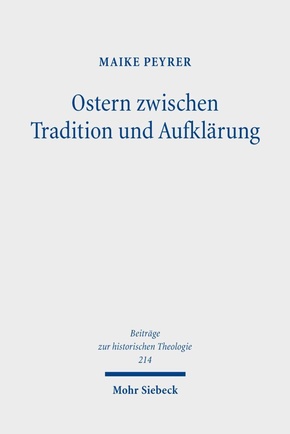
Ostern zwischen Tradition und Aufklärung - Die Deutung der Auferstehung Jesu in protestantischen Osterpredigten der späten Aufklärungszeit
Reduzierte Artikel in dieser Kategorie

10,99 €
| Verlag | Mohr Siebeck |
| Auflage | 29.05.2026 |
| Seiten | 238 |
| Format | 24,3 x 16,4 x 2,1 cm |
| Gewicht | 506 g |
| Reihe | Beiträge zur historischen Theologie / BHTh |
| ISBN-10 | 3161705963 |
| ISBN-13 | 9783161705960 |
| Bestell-Nr | 16170596A |
The resurrection of Jesus is one of the core elements of the Christian faith and thus one of the central themes of Christian theology. With the theological new beginnings brought about by the Enlightenment in the 18th century, and the accompanying criticism of dogma, the Bible, and miracles, the question of the truth and reality of Jesus' resurrection became the subject of intense theological controversy, as is particularly evident in the so-called "Fragmentenstreit" (Fragment Controversy) of the time. Maike Peyrer examines the extent to which these theological debates and their differing interpretations of Jesus' resurrection are reflected in the sermons of the period. She regards sermons as a theologically and historically relevant genre situated at the intersection between theoretical, academically informed theology and religious life shaped by the church. Through the analysis of various Easter sermons by sixteen Protestant preachers of the late Enlightenment, she investigates how the resurrection of Jesus was preached in a time marked by the struggle to define the relationship between reason and revelation, and in which belief in miracles - such as the resurrection itself - was increasingly called into question. The results of these analyses can be summarized in the title of this work: Easter between tradition and Enlightenment. The interpretations of the resurrection of Jesus found in the sermon manuscripts range from traditional Christological and soteriological emphases, to the highlighting of eschatological meaning, to moral-ethical and anthropocentric approaches.
Inhalt:
I. Einleitung
1. Forschungsinteresse und Fragestellung
2. Quellenmaterial und -auswahl
3. Forschungslage
4. Methodik und Aufbau
II. Theologiegeschichtlicher Kontext
1. Innerprotestantische Strömungen im späten 18. Jahrhundert
2. Der Fragmentenstreit
3. Predigt im späten 18. Jahrhundert
III. Predigtanalysen
1. Osterpredigten der lutherischen Spätorthodoxie
2. Osterpredigten des Spätpietismus
3. Osterpredigten der Aufklärungstheologie
4. Osterpredigten des jungen Friedrich Schleiermacher
IV. Zusammenschau und Ausblick
