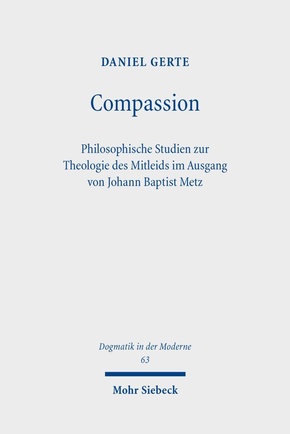
Compassion - Philosophische Studien zur Theologie des Mitleids im Ausgang von Johann Baptist Metz
Reduzierte Artikel in dieser Kategorie

| Verlag | Mohr Siebeck |
| Auflage | 14.10.2026 |
| fadengeheftete Broschur | |
| Reihe | Dogmatik in der Moderne / DoMo |
| ISBN-10 | 3162006376 |
| ISBN-13 | 9783162006370 |
| Bestell-Nr | 16200637A |
For Metz, compassion is not an isolated topic, but must be understood within the broader context of his thought and requires further development using contemporary conceptual frameworks. Drawing on selected critiques of political theology, within which compassion is embedded, it makes sense to develop 'narrative-practical Christianity' into 'mytho-compassionate Christianity'. The task is to provide a philosophical and theological foundation and contextualisation for compassion.
In terms of the theses and arguments, the methodological approaches are re-organising and analytical, constructive and critical, and thus hermeneutical. Furthermore, the ongoing comparison with the selected existential thinkers reveals an existential integration of theology in Metz's work.
Mytho-compassionate Christianity symbiotically unites the transcendent, unapproachable God and the world in need of salvation. If every capacity for reason and language follows the (arche)type; if mythology seeks to put into words precisely that which is beyond words; if religiosity - in particular Christian, ecclesiologically shaped religiosity - is constitutive and memory-forming, if a central element of this anamnetic structure is compassion, and if liturgical practice constantly brings to mind the life and work of Jesus - including in an imperative sense - then an immediate connection arises between the one Being and compassion, between imagery and compassion. For Christians, the power of compassion arises from the mythological, imagery-rich (linguistic) gesture of the liturgical-anamnetic reconnection with the Triune God. Any attempts to differentiate, categorise and prioritise Christian thought and action leave out the original imagery of the One and fail to recognise its immanent interdependent structure.
Inhalt:
1. Einleitung
1.1 Themenstellung und Problemorientierung
1.2 Mitleid: Terminologische Abgrenzungen
1.3 Philosophische Kritik am Mitleid
1.4 Mitleid und politische Theologie
2. Existenz-orientiertes Denken bei Johann Baptist Metz
2.1 Die Wende zur Anthropozentrik
2.2 Der Schrei der Verzweiflung
2.3 Das Subjekt als politisches Subjekt
2.4 Die Existenz als Selbstvollzug
3. Compassion: theologisch-anthropologische Konturen
3.1 Biblisch-theologischer Zugang zur Compassion
3.2 Systematisch-theologische Implikationen
4. Compassion: gesellschaftlich-politische Dimensionen
4.1 Compassion in einer Zeit der Gotteskrise
4.2 Compassion als Weltprogramm
4.3 Compassion und das narrativ-praktische Christentum
5. Analogien zur Compassion in der evangelischen Theologie: Zwei Beispiele
5.1 Bonhoeffer und Metz
5.2 Moltmann und Metz
5.3. Quintessenz: Mut zum Sein
6. Analogien zur Compassion im existenz-orientierten Denken
6.1 Mitleid bei Arthur Schopenhauer
6.2 Kommunikation bei Karl Jaspers
6.3 Mitsein bei Martin Heidegger
6.4 Solidarität bei Hannah Arendt
6.5 Achtung bei Jeanne Hersch
7. Compassion als Bildungsauftrag: Kontexte und Konkretisierungen
7.1 Biblischer Rückbezug: Sehen und doch nicht sehen (Mk 4)
7.2 Fürsorge und Prosozialität: Kontextuelle Einordnung der Gefühle
7.3 Theologisch-pädagogische Annäherungen
7.4 Die Freiheit verantworten: Habituelle Bildung
8. Das mytho-compathische Christentum: Ein Paradigma zur Theoriebildung
8.1 Kritische Aspekte zur politischen Theologie
8.2 Theologische Implikationen zur Erinnerungskultur
8.3 Kulturwissenschaftliche Theorien zu Gedächtnis und Erinnerung
8.4 Das mytho-compathische Christentum
8.5 Compathische Bildung durch Erinnerung
9. Schluss
