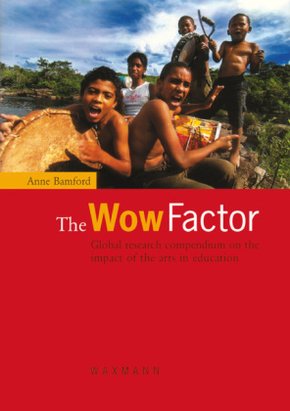
The Wow Factor - Global research compendium on the impact of the arts in education
Reduzierte Artikel in dieser Kategorie

10,99 €
| Verlag | Waxmann Verlag GmbH |
| Auflage | 2006 |
| Seiten | 178 |
| Format | 21 cm |
| Gewicht | 270 g |
| ISBN-10 | 3830916175 |
| ISBN-13 | 9783830916178 |
| Bestell-Nr | 83091617A |
More than ever before, the arts are shaping and influencing our daily lives through the media and the creative industries. The arts are no longer confined to museums and theatres, but are adding value to our national economies and improving the quality of education. This has implications for arts education. However, unlike other Subjects taught at schools, the arts have rarely made their purpose clear: Why are they taught? What is good arts education? And what are the benefits of teaching creative Subjects or using creative ways to teach?
In 2004 Professor Anne Bamford conducted the first international analysis of arts education research for UNESCO, in partnership with IFACCA and the Australia Council. Comparing data and case studies from more than 60 countries, the book analyses the differences between 'education in the arts' and 'education through the arts'. While appreciating that arts programmes are embedded in their unique social and cultural contexts, Professor Bamford develops internationally comparable standards for quality arts education. In addition, she identifies a number of concrete educational, cultural, and social benefits of arts education.
This definitive work is of major interest to policy-makers, educators and artists.
More than ever before, the arts are shaping and influencing our daily lives through the media and the creative industries. The arts are no longer confined to museums and theatres, but are adding value to our national economies and improving the quality of education. This has implications for arts education. However, unlike other Subjects taught at schools, the arts have rarely made their purpose clear: Why are they taught? What is good arts education? And what are the benefits of teaching creative Subjects or using creative ways to teach?
In 2004 Professor Anne Bamford conducted the first international analysis of arts education research for UNESCO, in partnership with IFACCA and the Australia Council. Comparing data and case studies from more than 60 countries, the book analyses the differences between 'education in the arts' and 'education through the arts'. While appreciating that arts programmes are embedded in their unique social and cultural contexts, Professor Bamford develops internationally comparable standards for quality arts education. In addition, she identifies a number of concrete educational, cultural, and social benefits of arts education.
This definitive work is of major interest to policy-makers, educators and artists.
Inhaltsverzeichnis:
1;Contents;8
2;Executive summary;10
2.1;Objectives;10
2.2;Methods;11
2.3;Conclusions/Observations;12
2.4;Quality Education and Education for All: The role of the arts;13
3;Acknowledgements;16
4;Preface;18
5;Chapter 1: The arts are intrinsic;20
5.1;Introduction;20
5.2;Arts education involves;21
5.3;Starting point for the research;24
5.4;Organisation of the book;25
6;Chapter 2: Social, political and historical context for thinking about arts education;30
6.1;Introduction;30
6.2;Social and historical influence on arts education;31
6.3;Challenges in arts education;38
7;Chapter 3: Underpinning research;42
7.1;The data;42
7.2;The analysis;44
7.3;Problems concerning quantitative interpretation;45
8;Chapter 4: The scope and nature of arts education;48
8.1;Introduction;48
8.2;What does art education include?;49
8.3;Who is responsible for supporting arts education?;53
8.4;Responsibilities for arts education policy;58
8.5;The place of arts education in the curriculum;60
8.6;Arts education policy;62
8.7;The role of arts education policy in general education policy;67
8.8;Distinction between education in the arts and education through the art;71
9;Chapter 5: Arts education in practice;74
9.1;Introduction;74
9.2;The arts learning environment;74
9.3;Responsibilities for delivery of arts education programmes;75
9.4;Teacher education;80
9.5;Arts education s contribution to teacher professional development;84
10;Chapter 6: Goals and indications of quality in arts-rich education;86
10.1;Introduction;86
10.2;Quality Education and Education for All: The role of the arts;87
10.3;Characteristics of quality arts education;89
11;Chapter 7: The impact of arts education;104
11.1;Introduction;104
11.2;The goals of arts education;104
11.3;Arts-rich education improves achievement in the arts;105
11.4;Arts education s contribution to improved student educational attainment and academic achievement;108
11.5;Arts education s contribution to improved student attitude;116
11.6;Arts education and the community;123
11.7;Arts education, imagination and creativity;129
11.8;Arts education, health and well-being;134
11.9;Arts education and technology;138
12;Chapter 8: Conclusions and future directions;140
12.1;Introduction;140
13;References;152
14;Index;156
15;Appendix One: Copy of survey;158
16;Appendix Two: List of responding countries, ministries and/or organisations;173
17;Appendix Three: Research case study titles listed by country (these are in addition to the surveys and research listed in Appendix 2);177
18;Appendix Four: Other countries also consulted (not survey respondents);179
