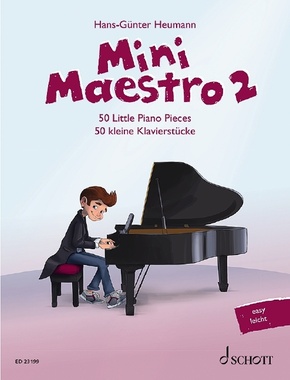
Mini Maestro - 50 kleine Klavierstücke. Band 2. Klavier.
Reduzierte Artikel in dieser Kategorie

5,99 €
8,99 €
5,99 €
| Verlag | Schott Music, Mainz |
| Auflage | 2020 |
| Seiten | 72 |
| Format | 23,1 x 30,1 x 0,8 cm |
| Noten (Rückendrahtheftung) | |
| Gewicht | 290 g |
| ISBN-10 | 3795719070 |
| ISBN-13 | 9783795719074 |
| Bestell-Nr | 79571907A |
The three-volume collection Mini Maestro presents little piano pieces advancing progressively from very easy to intermediate level, presented in chronological order across five centuries from the Baroque, Classical, Romantic and Modern eras through to jazz, pop and minimal music. At the end of each volume - under the heading More fun to play together - there are three additional pieces for piano duet. All the pieces are easy to learn and offer varied repertoire as an ideal supplement to any piano tutorial method with music suitable for concert performance, tuition purposes, examinations and competitions. Book 1 contains pieces in the five-finger range at various pitches, followed by pieces spanning an octave range with simple rhythms and easy chord sequences. Also featured are differing styles of articulation, melody in the left hand, octave or ottava signs, pieces in major and minor keys with key signatures of up to one sharp or flat. Book 2 contains pieces with an extended range of two octaves and chord sequences with three or four parts, including inversions. Other features include using the pedal, simple ornaments, basic polyphony, differentiating melody and accompaniment, pieces in major and minor keys with key signatures of up to two sharps or flats. Book 3 contains pieces with a range of up to four octaves with more demanding rhythms and speeds. Also included are subtle contrasts in tone, playing with expression, playing more than one part with one hand and advanced polyphony in major and minor keys with key signatures of up to three sharps or flats.Instrumentation:piano
Die dreibändige Sammlung Mini Maestro präsentiert sehr leichte bis mittelschwere, progressiv angeordnete kleine Klavierstücke aus 5 Jahrhunderten in chronologischer Reihenfolge von Barock, Klassik, Romantik, Moderne bis hin zu Jazz, Pop und Minimal Music. Das Ende eines jeden Bandes bilden - unter dem Motto Zu Zweit mehr Spaß - jeweils drei vierhändige Bonusstücke. Alle Spielstücke sind leicht zu erlernen und bieten ein vielfältiges Repertoire als ideale Ergänzung zu jeder Klavierschule, geeignet für Konzert, Unterricht, Prüfungen sowie Wettbewerbe.
Band 1 enthält Stücke im Fünftonraum/in wechselnden Fünftonräumen, danach Stücke im Oktavraum mit einfacher Rhythmik und leichtem Akkordspiel. Weitere Kriterien sind die unterschiedliche Artikulation, Melodie in der linken Hand, Oktavierungszeichen und Dur-/Mollstücke bis zu einem Kreuz-/B-Vorzeichen.
Band 2 enthält Stücke im erweiterten Tonumfang von zwei Oktaven und drei- bis vierstimmigem Akkordspiel mit Umkehrungen. Weitere Kriterien sind das Pedalspiel, elementare Verzierungen, einfache Polyphonie, Differenzierung von Melodie und Begleitung und Dur-/Mollstücke bis zu zwei Kreuz-/B-Vorzeichen.
Band 3 enthält Stücke bis zu vier Oktaven Tonumfang, anspruchsvollere Rhythmik und Geläufigkeit. Weitere Kriterien sind subtile klangliche Differenzierungen, ausdrucksvolles Spiel, Mehrstimmigkeit in einer Hand, fortgeschrittene Polyphonie sowie Dur-/Mollstücke bis zu drei Kreuz-/B-Vorzeichen.
Schwierigkeitsgrad: 2
Inhaltsverzeichnis:
John Blow (1649-1708): Air - Johann Krieger (1651-1735): Menuett a-Moll - Christian Petzold (1677-1733): Menuett G-Dur, BWV Anh. 114, Menuett g-Moll, BWV Anh. 115 - Johann Sebastian Bach (1685-1750): Aria d-Moll, BWV 515, Praeludium C-Dur, BWV 939 - Georg Friedrich Händel (1685-1759): Gavotte C-Dur, Passepied C-Dur, HWV 559 - Joseph Haydn (1732-1809): Deutscher Tanz D-Dur, Hob. IX:22/2, Menuett F-Dur, Hob. IX:8/12 - Wolfgang Amadeus Mozart (1756-1791): Menuett F-Dur, KV 2, Allegro B-Dur, KV 3 - Ludwig van Beethoven (1770-1827): Deutscher Tanz C-Dur, WoO 8/1, Ecossaise G-Dur, WoO 23 - Anton Diabelli (1781-1858): Tempo di Menuetto, Op. 125/8, Vivace, Op. 125/7 - Friedrich Kuhlau (1786-1832): Zwei schottische Tänze Nr. 2, Nr. 5 - Carl Maria von Weber (1786-1826): Allemande, Op. 4/2 - Maria Szymanowska (1789-1831): Mazurka - Ignaz Moscheles (1794-1870): Scherzo, Op. 55/3 - Robert Schumann (1810-1856): Stückchen, Op. 68/5 - Félix Le Couppey (1811-1887): Arabische Melodie - Cornelius Gurlitt (1820-1901): Klavierstück, Op. 179/22, Gavotte, Op. 210/9 - Carl Reinecke (1824-1910): Lied, Serenade 1, Op. 183 - Eduard Horák (1838-1893): Scherzino - Oskar Bolck (1839-1888): Sonatine C-Dur, Op. 30/4, Allegro, Andante, Rondino: Vivace - Frederick Scotson Clark (1840-1883): Tarantella - Peter Iljitsch Tschaikowsky (1840-1893): Die kranke Puppe, Op. 39/6 - Alexander Gretchaninoff (1864-1956): Ein kleines Tänzchen, Op. 98/10, Nach dem Balle, Op. 98/13 - Samuil Maikapar (1867-1938): Walzer, Op. 28/5 - Béla Bartók (1881-1945): Spiel, Wehmut, Walzer - Carl Orff (1895-1982): Klavier-Übung No. 20 - John Kember (*1935): Simply Blue - Loris Tjeknavorian (*1937): Lustige Unterhaltung - George Nevada (1939-2014): Wenn Paris träumt - Jürgen Moser (*1949): Feelin' Groovy - Rainer Mohrs (*1953): A Song of Hope - Hans-Günter Heumann (*1955): Cool Jazz Cats, Magic Piano, Regenbogen-Fee, Modern Sonatina: 1 À la Clementi, 2 Pop Ballad, 3 Boogie-Woogie - Drei vierhändige Bonusstücke: - Anton Diabelli (1781-1858): Scherzo, Op. 149/6 - Franz Schubert (1797-1828): Ländler, D 366/5 - Mike Schoenmehl (*1957): Fips in the Park
