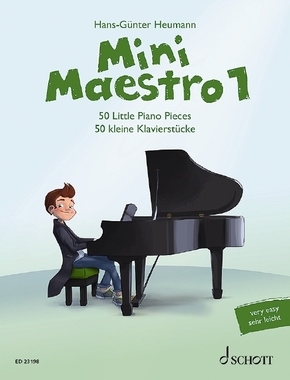
Mini Maestro - 50 kleine Klavierstücke. Band 1. Klavier.
Reduzierte Artikel in dieser Kategorie

5,99 €
8,99 €
5,99 €
| Verlag | Schott Music, Mainz |
| Auflage | 2020 |
| Seiten | 64 |
| Format | 23,0 x 30,1 x 0,7 cm |
| Noten (Rückendrahtheftung) | |
| Gewicht | 266 g |
| ISBN-10 | 3795719062 |
| ISBN-13 | 9783795719067 |
| Bestell-Nr | 79571906A |
The three-volume collection Mini Maestro presents little piano pieces advancing progressively from very easy to intermediate level, presented in chronological order across five centuries from the Baroque, Classical, Romantic and Modern eras through to jazz, pop and minimal music. At the end of each volume - under the heading More fun to play together - there are three additional pieces for piano duet. All the pieces are easy to learn and offer varied repertoire as an ideal supplement to any piano tutorial method with music suitable for concert performance, tuition purposes, examinations and competitions. Book 1 contains pieces in the five-finger range at various pitches, followed by pieces spanning an octave range with simple rhythms and easy chord sequences. Also featured are differing styles of articulation, melody in the left hand, octave or ottava signs, pieces in major and minor keys with key signatures of up to one sharp or flat. Book 2 contains pieces with an extended range of two octaves and chord sequences with three or four parts, including inversions. Other features include using the pedal, simple ornaments, basic polyphony, differentiating melody and accompaniment, pieces in major and minor keys with key signatures of up to two sharps or flats. Book 3 contains pieces with a range of up to four octaves with more demanding rhythms and speeds. Also included are subtle contrasts in tone, playing with expression, playing more than one part with one hand and advanced polyphony in major and minor keys with key signatures of up to three sharps or flats.Instrumentation:piano
Die dreibändige Sammlung Mini Maestro präsentiert sehr leichte bis mittelschwere, progressiv angeordnete kleine Klavierstücke aus 5 Jahrhunderten in chronologischer Reihenfolge von Barock, Klassik, Romantik, Moderne bis hin zu Jazz, Pop und Minimal Music. Das Ende eines jeden Bandes bilden - unter dem Motto Zu Zweit mehr Spaß - jeweils drei vierhändige Bonusstücke. Alle Spielstücke sind leicht zu erlernen und bieten ein vielfältiges Repertoire als ideale Ergänzung zu jeder Klavierschule, geeignet für Konzert, Unterricht, Prüfungen sowie Wettbewerbe.Band 1 enthält Stücke im Fünftonraum/in wechselnden Fünftonräumen, danach Stücke im Oktavraum mit einfacher Rhythmik und leichtem Akkordspiel. Weitere Kriterien sind die unterschiedliche Artikulation, Melodie in der linken Hand, Oktavierungszeichen und Dur-/Mollstücke bis zu einem Kreuz-/B-Vorzeichen.Band 2 enthält Stücke im erweiterten Tonumfang von zwei Oktaven und drei- bis vierstimmigem Akkordspiel mit Umkehrungen. Weitere Kriterien sind das Pedalspiel, elementare Verzierungen, einfache Polyphonie, Differenzierung von Melodie und Begleitung und Dur-/Mollstücke bis zu zwei Kreuz-/B-Vorzeichen.Band 3 enthält Stücke bis zu vier Oktaven Tonumfang, anspruchsvollere Rhythmik und Geläufigkeit. Weitere Kriterien sind subtile klangliche Differenzierungen, ausdrucksvolles Spiel, Mehrstimmigkeit in einer Hand, fortgeschrittene Polyphonie sowie Dur-/Mollstücke bis zu drei Kreuz-/B-Vorzeichen.Schwierigkeitsgrad: 1
Inhaltsverzeichnis:
Michael Praetorius (1571-1621): Alter deutscher Tanz C-Dur - Anonymus (ca. 1600): Alter deutscher Tanz G-Dur - James Hook (1746-1827): Menuett C-Dur - Alexander Reinagle (1756-1809): Allegro, Op. 1/4 - Charles Henry Wilton (1761-1832): Kleine Sonate C-Dur Moderato, Minuetto - Félix Le Couppey (1811-1887): Melodie No. 12 - Kaspar Jakob Bischoff (1823-1893): Der eifrige Schüler, Op. 31/3 - Friedrich Baumfelder (1836-1916): Melodie F-Dur - Oskar Bolck (1839-1888): Sonatine C-Dur, Op. 30/2 Allegro, Andantino, Vivace - Moritz Wilhelm Vogel (1846-1922): Mutiger Ritter - Kálmán Chován (1852-1928): Klavierstück G-Dur - Erik Satie (1866-1925): Kleines Vorspiel für den Tag, Profiter de ce qu'il a des cors aux pieds pour lui prendre son cerceau - Béla Bartók (1881-1945): Volkslied - Georges Frank Humbert (1892-1958): Die Kuckucksuhr, Der nickende Mandarin - Marko Tajcevic (1900-1984): Für die Jugend, Klavierstück Nr. 1 - Henk Badings (1907-1987): Kanon - Barbara Heller (*1936): Und immer noch mal... - Hans-Günter Heumann (*1955): Holzschuhtanz, Spanischer Gitarrenspieler, Harlekin-Walzer, It's Ragtime, Five-Note Rock, Little Pop Ballad, Northern Folk Dance, Boogie-Woogie Spirit - Henry Purcell (1659-1695): Air d-Moll - Georg Friedrich Telemann (1681-1767): Gavotte C-Dur - Christoph Graupner (1683-1760): Bourée e-Moll - Jean-Philippe Rameau (1683-1764): Menuet en Rondeau C-Dur - Leopold Mozart (1719-1787): Menuett d-Moll - Anonymous: Menuett F-Dur - Daniel Gottlob Türk (1750-1813): Der muntere Knabe - Wiegenlied - Muzio Clementi (1752-1832): Arietta, Op. 42/5 - Anton Diabelli (1781-1858): Allegretto, Op. 125/3 - Charles Villiers Stanford (1852-1924): Scherzo F-Dur - Alexander Gretchaninoff (1864-1956): Abschied, Op. 98/4 - Samuil Maikapar (1867-1938): Ein Märchen, Op. 28/10 - Träumerei, Op. 33/2 - Thomas Frederick Dunhill (1877-1946): Gavotte G-Dur - Béla Bartók (1881-1945): Quasi adagio - Carl Orff (1895-1982): Klavier-Übung Nr. 6 - Friedrich Zehm (1923-2007): Melodie - Hans-Günter Heumann (*1955): Tarantella d-Moll - Drei vierhändige Bonusstücke: - Anton Diabelli (1781-1858): Melodisches Übungsstück, Op. 149/4 - Franz Schubert (1797-1828): Ländler, D 366/3 - Mátyás Seiber (1905-1960): Tango
