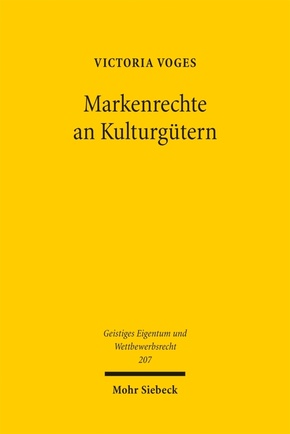
Markenrechte an Kulturgütern - Möglichkeiten und Auswirkungen der markenspezifischen Kommodifizierung
Reduzierte Artikel in dieser Kategorie

21,99 €
| Verlag | Mohr Siebeck |
| Auflage | 1. Auflage, 19.05.2026 |
| fadengeheftete Broschur | |
| Reihe | Geistiges Eigentum und Wettbewerbsrecht GEuWR |
| ISBN-10 | 3162002664 |
| ISBN-13 | 9783162002662 |
| Bestell-Nr | 16200266A |
For decades, it has been possible to observe that both private companies and public institutions have registered culturally significant assets as trademarks. Through registration and use as a trademark, the cultural asset is instrumentalized for commercial purposes, usually with a strong consumer focus. Victoria Voges examines whether trademark law, in its current form, grants overly far-reaching exclusive rights shaped by commercial interests. She demonstrates that the legal protection of cultural-asset trademarks has adverse effects on the cultural asset itself as well as on culture as a whole. These effects are not only undesirable from a perspective of cultural studies; legally enshrined culture-related principles-especially those deriving from the state's responsibility for culture-also argue against granting protection. Trademark law neither comprehensively prevents nor sufficiently limits the negative effects on the original cultural asset and on culture as a mechanism. Rather, the specific design of trademark law and developments observed in recent years lead to a more rapid devaluation of the cultural assets concerned. This cultural problem could most plausibly be addressed by integrating it into the ground for refusal based on a violation of public policy (§ 8(2) no. 5, alternative 1 MarkenG) and dealing with it on that basis. The state's responsibility for culture can be classified as a constitutional principle and thus as part of public policy. Methodologically, the author draws in particular on cultural-semiotic explanatory models.
Inhalt:
Einleitung
Anlass der Untersuchung - Forschungsstand - Untersuchungsgegenstand und -methoden - Gang der Untersuchung
Konturierung des Verständnisses von Kultur und Kulturgütern
Perspektive der Rechtswissenschaften - Perspektive der Kulturwissenschaften - Definition des Kulturguts
Analyse der Auswirkungen von Kulturgütermarken
Gestalt und Zwecke des Markenrechts - Semiotische Einordnung von Kulturgütermarken - Rechtliche Einordnung der semiotischen Effekte von Kulturgütermarken
Einfluss der konkreten Ausgestaltung des Markenrechts auf nachteilige Auswirkungen von Kulturgütermarken
Mögliche Verhinderung von Kulturgütermarken - Mögliche Begrenzung der nachteiligen Auswirkungen - Verstärkung der nachteiligen Auswirkungen - Ergebnis zum Einfluss der konkreten Ausgestaltung des Markenrechts
