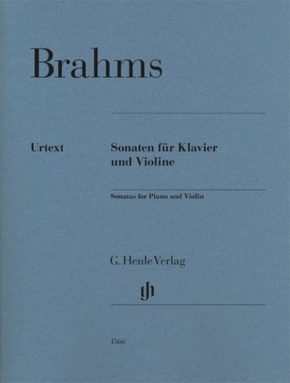
Johannes Brahms - Violinsonaten - Besetzung: Violine und Klavier
Reduzierte Artikel in dieser Kategorie

5,99 €
8,99 €
| Verlag | Henle |
| Auflage | 2022 |
| Seiten | 189 |
| Format | 23,5 x 0,7 x 31,1 cm |
| Gewicht | 798 g |
| Reihe | G. Henle Urtext-Ausgabe |
| ISBN-13 | 9790201815664 |
| Bestell-Nr | 96071788BA |
Brahms early on engaged with the violin sonata genre. As early as 1853 he wrote a sonata in a minor, which - like so many other youthful works of this self-critical composer - no longer survives. Thus the G-major sonata op. 78, written in 1878/79, is now counted as his first contribution to the genre; it has the nickname "Regenlied Sonata" (literally "rain-song sonata") because of the quotation from a song that appears in the finale. In summer 1886 Brahms composed, almost simultaneously, the two sonatas op. 100 and 108. All three works now have a firm place in the violinistic canon.
We round off our volume with the Scherzo in c minor that Brahms contributed to the so-called "F.A.E Sonata", which he composed together with Robert Schumann and Albert Dietrich as a gift for violinist Joseph Joachim in 1853. With its stark contrast between the turbulent allegro and the emotional più moderato part, his scherzo has become a popular bravura and encore piece.
The present new edition is based on the New Brahms Complete Edition, and offers a musical text and commentary that have been revised according to the latest research. The fingering is by respective masters of their instruments Frank Peter Zimmermann and Martin Helmchen.
Johannes Brahms s'est occupé très tôt du genre de la sonate pour violon. Dès 1853 il composait une Sonate en la mineur, toutefois disparue - comme tant d'oeuvres de jeunesse du compositeur, victimes peut-être de son autocritique. Ainsi considère-t-on aujourd'hui la Sonate en Sol majeur op. 78, datant de 1878/1879, comme sa première contribution au genre; la présence d'une citation de lied dans le mouvement final a conféré à la sonate le surnom de «Regenlied» (Chant de la pluie). C'est à l'été 1886 que Brahms a composé presque en même temps les deux Sonates op. 100 et op. 108. Les trois oeuvres ont pris bonne place dans le canon du répertoire de violon.
Ce volume est complété par le Scherzo en ut mineur, avec lequel Brahms apporta sa contribution à ce qui est appelé la «Sonate F.A.E.» qui fut composée en commun aux côtés de Robert Schumann et de Albert Dietrich en 1853, en guise de cadeau d'anniversaire offert au violoniste Joseph Joachim. Avec ses rudes contrastes entre son Allegro furieux et sa partie plus modérée («Più-Moderato») pleine de sentiments, ce Scherzo est très populaire en tant que morceau de bravoure ou comme «bis».
La présente nouvelle édition se fonde sur la nouvelle édition intégrale de Brahms, et présente un texte musical revu et commenté en fonction du plus récent état de la recherche. Les doigtés proviennent de véritables maîtres en la matière: Frank Peter Zimmermann et Martin Helmchen.
Johannes Brahms befasste sich früh mit der Gattung der Violinsonate. Bereits 1853 komponierte er eine Sonate in a-moll, die jedoch - wie so viele Frühwerke des selbstkritischen Komponisten - verschollen ist. Daher wird heute die 1878/79 entstandene G-dur-Sonate op. 78 als sein erster Beitrag zur Gattung gezählt; aufgrund eines Liedzitats im Finalsatz trägt sie den Beinamen "Regenlied-Sonate". Im Sommer 1886 komponierte Brahms nahezu gleichzeitig die beiden Sonaten op. 100 und 108. Alle drei Werke haben sich ihren festen Platz im Kanon der Violinliteratur erobert.
Abgerundet wird dieser Band durch das Scherzo in c-moll, das Brahms zur sogenannten F.A.E.-Sonate beisteuerte, die er zusammen mit Robert Schumann und Albert Dietrich 1853 als Geschenk für den Geiger Joseph Joachim komponierte. Mit seinen scharfen Gegensätzen zwischen dem grimmigen Allegro- und dem gefühlvollen Più-Moderato-Teil ist das Scherzo ein beliebtes Bravour- und Zugabestück.
Die vorliegende Neuausgabe basiert auf der Neuen Brahms-Gesamtausgabe und liefert damit einen nach neuestem Forschungsstand revidierten und kommentierten Notentext. Die Fingersätze stammen von wahren Meistern ihres Fachs: Frank Peter Zimmermann und Martin Helmchen.
Inhaltsverzeichnis:
Violinsonate Nr. 1 G-dur op. 78Violinsonate Nr. 2 A-dur op. 100Violinsonate Nr. 3 d-moll op. 108Allegro c-moll WoO posth. 2
