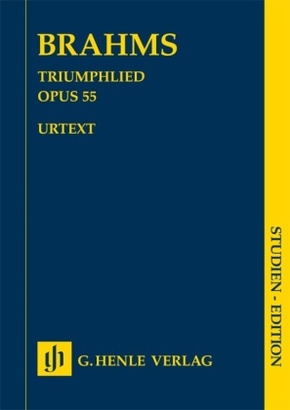
Johannes Brahms - Triumphlied op. 55 - Besetzung: Vokalwerke mit Orchester
Reduzierte Artikel in dieser Kategorie

5,99 €
| Verlag | Henle |
| Auflage | 2022 |
| Seiten | 160 |
| Format | 17,2 x 1,5 x 24,0 cm |
| Gewicht | 345 g |
| Reihe | Studien-Editionen |
| ISBN-13 | 9790201890302 |
| Bestell-Nr | 95584450BA |
Brahms composed his Triumphlied for eight-part chorus, solo baritone and orchestra as a direct reaction to the victory of the German army in the Franco-Prussian War of 1870/71 and the consequent founding of the German Empire. Similar to the German Requiem completed shortly before, Brahms himself compiled the text from the Bible, in this case from Chapter 19 of the Book of Revelations. Because of the somewhat melodramatic tone of the composition and the nationalistic background to the work's genesis, in recent years the Triumphlied has seldom been heard in concert halls. Unlike overly-patriotic occasional works such as Richard Wagner's Kaisermarsch, the Triumphlied is "true Brahms" and is a musically rich composition. This study edition takes the musical text from the Brahms Complete Edition (HN 6030), thereby representing the highest scholarly precision. The Appendix contains an exciting new discovery, a previously-unknown early version of the 1st movement in C major, which was only rediscovered in 2012 in Bremen.
Brahms composa son Triumphlied (Chant triomphal) pour choeur à huit voix, baryton solo et orchestre en réaction directe à la victoire de l'armée allemande lors de la guerre franco-germanique de 1870-1871 et à la fondation du Reich impérial qui en a résulté. Comme pour le Requiem allemand achevé peu avant, Brahms en a compilé lui-même le texte à partir de fragments de la Bible - en l'occurrence le chapitre 19 de l'Apocalypse de Jean. En raison du pathos qui marque quelque peu la composition et du contexte de sa création, empreint de nationalisme, l'oeuvre n'a que rarement trouvé le chemin des salles de concerts dans les temps actuels. Au contraire d'ouvrages de circonstance au patriotisme démonstratif comme la Kaisermarsch (Marche impériale) de Richard Wagner, il s'agit, avec le Triumphlied, d'une pièce authentiquement brahmsienne, d'une réelle substance musicale. La présente partition d'étude reprend le texte musical de l'édition intégrale des oeuvres de Brahms (HN 6030), garant de la plus haute exactitude scientifique. Une passionnante découverte figure en annexe : une version précoce du premier mouvement, en Ut majeur, inconnue jusqu'alors et découverte à Brême en 2012 seulement.
Brahms komponierte sein Triumphlied für achtstimmigen Chor, Solo-Bariton und Orchester als unmittelbare Reaktion auf den Sieg der deutschen Armee im deutsch-französischen Krieg 1870/71 und die daraus resultierende Gründung des deutschen Kaiserreichs. Ähnlich wie im kurz zuvor vollendeten Deutschen Requiem stellte Brahms den Text selbst aus der Bibel zusammen, in diesem Fall aus dem 19. Kapitel der Offenbarung des Johannes. Bedingt durch den etwas pathetischen Tonfall der Komposition und die nationalistisch gefärbten Entstehungsumstände hat das Triumphlied in neuerer Zeit selten den Weg in den Konzertsaal gefunden. Im Gegensatz zu hurra-patriotischen Gelegenheitswerken wie Richard Wagners Kaisermarsch handelt es sich beim Triumphlied aber um "echten Brahms" und eine musikalisch gehaltvolle Komposition. Die vorliegende Studien-Edition übernimmt den Notentext der Brahms-Gesamtausgabe (HN 6030) und steht somit für höchste wissenschaftliche Genauigkeit. Eine aufregende Neuentdeckung bietet der Anhang: Er enthält eine bisher unbekannte Frühfassung des 1. Satzes in C-dur, die erst 2012 in Bremen wiederaufgefunden wurde.
Inhaltsverzeichnis:
Triumphlied op. 55
