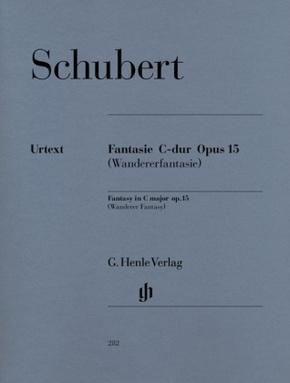
Franz Schubert - Fantasie C-dur op. 15 D 760 - Besetzung: Klavier zu zwei Händen
Reduzierte Artikel in dieser Kategorie

5,99 €
| Verlag | Henle |
| Auflage | 01.01.2000 |
| Seiten | 34 |
| Format | 23,5 x 31,0 x 0,4 cm |
| Gewicht | 162 g |
| Reihe | G. Henle Urtext-Ausgabe |
| ISBN-13 | 9790201802824 |
| Bestell-Nr | 13677840BA |
Schubert komponierte die Wandererfantasie im November 1822. Allgemein als Krisenjahr bezeichnet, entstanden aber gerade in dieser Zeit eine ganze Reihe seiner wichtigen Werke - gleichzeitig mit der Wandererfantasie z. B. auch die Symphonie in h-moll, die sog. "Unvollendete". Es gab mehrere Vorbilder, insbesondere die Fantasien C. Ph. E. Bachs und Mozarts. Schubert entwickelte die Gattung in diesem Meisterwerk jedoch weiter. Er kombinierte darin das Prinzip der Fantasie mit dem des Sonatenzyklus, indem er das Ganze in vier nahtlos ineinander übergehende Großabschnitte (Sätze) einteilte, dabei aber thematisch alles aus einem Kern ableitete, eben jenen aus dem Lied "Der Wanderer" entnommenen Takten im zweiten Satz. Als eines der wenigen Instrumentalwerke Schuberts erschien das Stück im Druck und wurde schon damals von der Kritik begeistert aufgenommen. Es gehört auch heute noch zu den vielgespielten, wenn auch technisch und musikalisch überaus anspruchsvollen Werken dieses Komponiste n.
Mehr zu dieser Ausgabe im Henle-Blog.
Inhaltsverzeichnis:
Fantasie (Wandererfantasie) C-dur op. 15 D 760
Schubert composed the Wandererfantasie in November 1822. Though generally designated as a year of crisis, an entire series of Schubert's important works were created precisely at this time, when the Wandererfantasie, for example, but also the Symphony in B minor, the "Unfinished," began to cast their spells on music lovers all over the world. There were several precursors, in particular the fantasias of Carl Philipp Emanuel Bach and Mozart. Nevertheless, Schubert continued to develop the genre in this masterpiece. He combined the principle of the fantasia with that of the sonata cycle, by dividing the whole into four large sections (movements) that flow seamlessly into one another, whereby he derived the thematic material from a core which - not surprisingly - consisted of measures borrowed from the song Der Wanderer in the second movement. This work was one of the few instrumental works of Schubert's to have appeared in print during his lifetime, and was already receiving encomiu ms from the critics back in its day. It still ranks today among the most often played yet technically and musically highly challenging works of this composer.
Read more about this edition in the Henle Blog.
